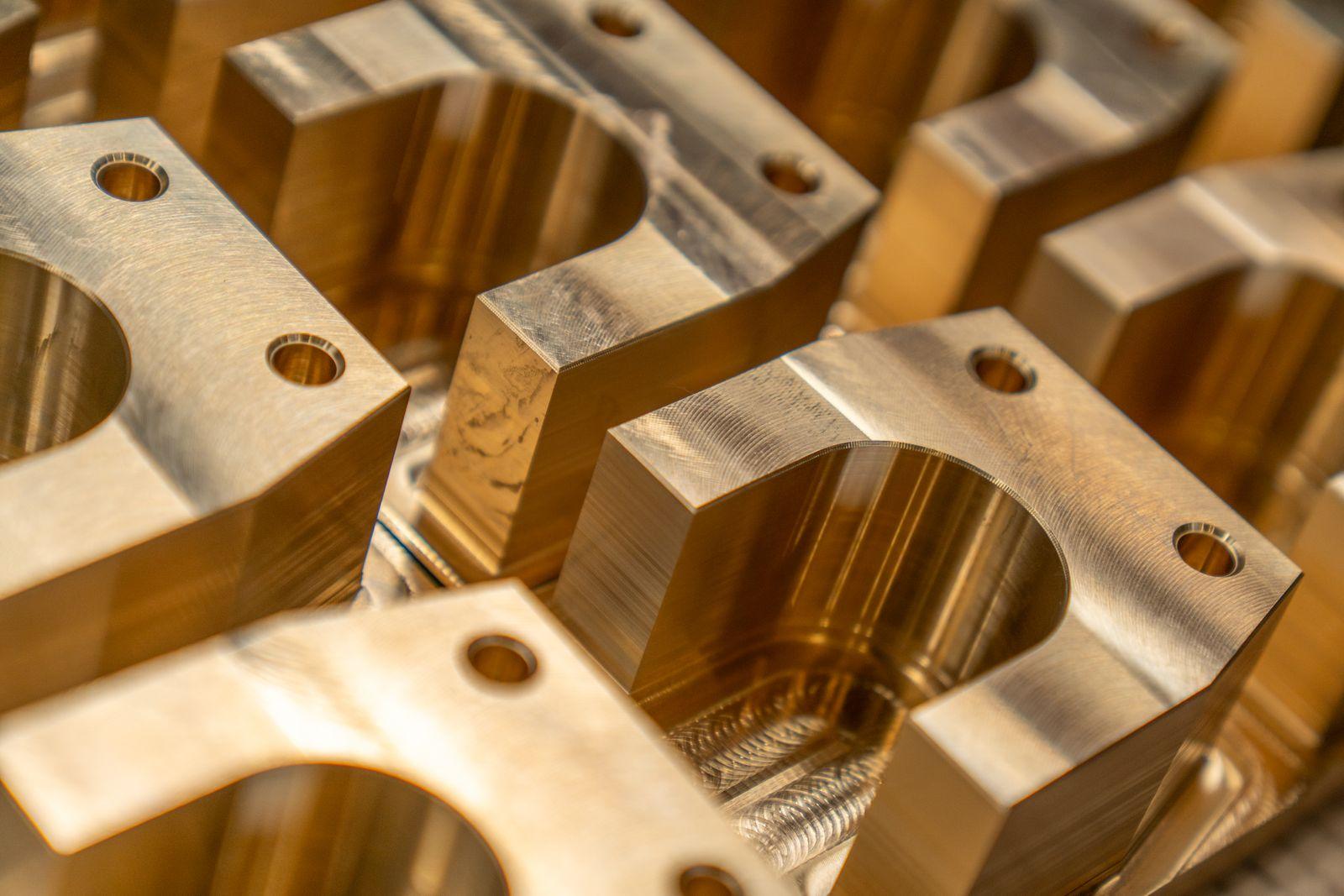
A finish can protect a part from corrosion, improve wear resistance, reduce friction, or simply make it look right. Choosing the right one, and specifying it clearly, avoids surprises when the parts arrive.
Surface roughness: the as-machined finish
Every machined surface has fine tool marks. Surface roughness is usually specified as Ra, the average roughness in micrometres. A general machined finish is often around Ra 3.2 µm. Finer values such as Ra 1.6 or 0.8 µm need extra finishing passes, and very fine values may need grinding, lapping, or polishing.
Deburring and edge breaking
Machining leaves sharp edges and small burrs. A note such as 'break all sharp edges' or a specific chamfer size tells the machinist how to treat edges. This matters for safety and for parts that must assemble smoothly.
Bead blasting
Blasting with fine glass beads gives a uniform matte texture that hides tool marks. It is often used on aluminium and stainless parts before anodising or for a consistent appearance. It slightly changes surface dimensions, so critical features may need masking.
Anodising (aluminium)
Anodising grows a hard oxide layer on aluminium that improves corrosion and wear resistance and can be dyed in colours. Hard anodising produces a thicker, more wear-resistant layer. Because the coating adds thickness, tight-tolerance features and threads should account for it.
Zinc plating and passivation (steel)
Zinc plating protects mild steel from rust at a low cost, and is common on brackets, fasteners, and general parts. A passivation layer on top improves corrosion resistance. Stainless steel is often passivated chemically to restore its natural corrosion resistance after machining.
Blackening (black oxide)
Blackening gives steel a dark finish with minimal dimensional change. On its own it offers limited protection, so parts are usually oiled afterwards. It is popular for tooling, fixtures, and machine components.
Nickel and chrome plating
Electroless nickel deposits an even coating, including inside holes and on complex shapes, and improves wear and corrosion resistance. Hard chrome is used on shafts and rods for wear resistance and is often ground afterwards to final size.
Powder coating and painting
Powder coating gives a durable, thick, coloured finish suitable for covers, frames, and visible parts. The coating thickness is significant, so mating faces and threaded holes are usually masked.
How to specify a finish
- Name the finish and, where relevant, the colour, class, or thickness.
- Mark surfaces that must be masked or left uncoated.
- State whether dimensions apply before or after finishing.
- Mention the finish in your quote request, since it affects lead time.
Summary
The right finish depends on the material, the environment, and the part's function. Decide what the finish needs to achieve, specify it only where it matters, and remember that coatings add thickness.
Have a part to make?
Send your drawings, CAD files, or a sample part and we'll come back with a straightforward quote.
Related services: Custom Parts Manufacturing · CNC Milling